
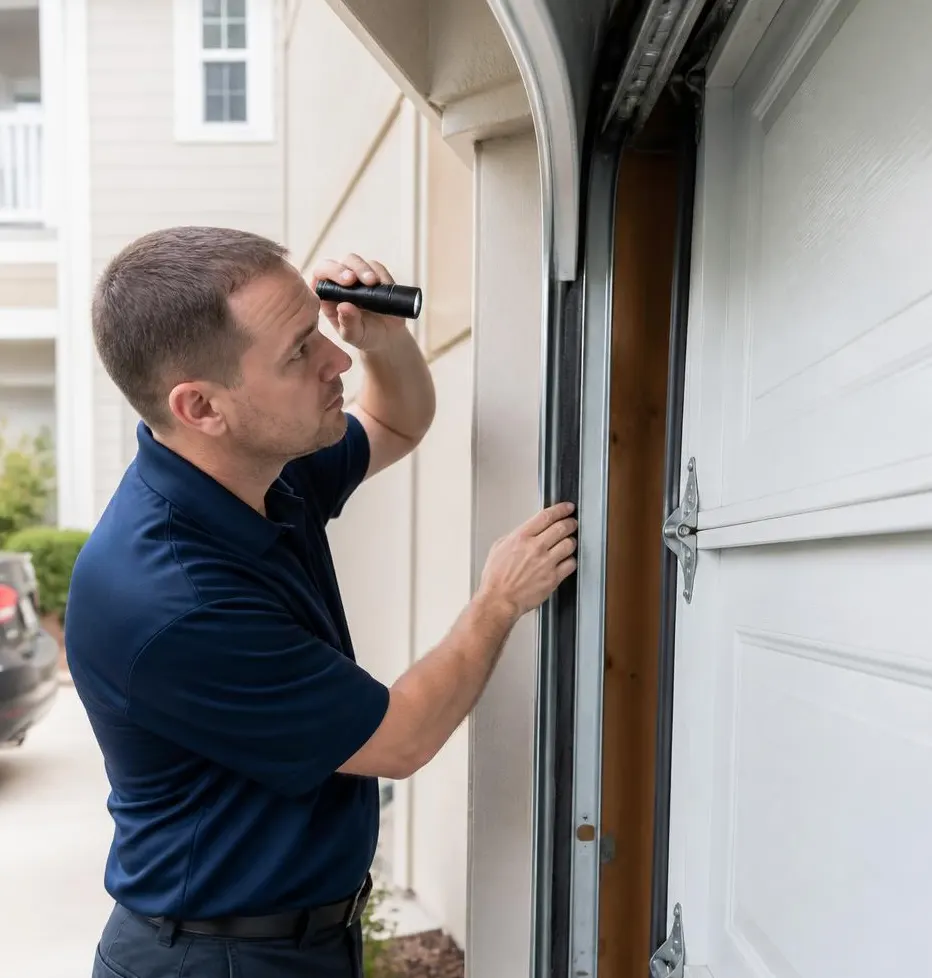
Why Your Casselberry Garage Door Keeps Popping Back Up Before It Closes
The short answer: most of the time it's a blocked or misaligned safety sensor, a close-force setting that's too sensitive, or something physically dragging on the track. Less often, it's a spring or cable problem, or the opener's logic board has failed. The good news is that a door doing this is actually easier to diagnose than one making a weird noise — the symptom itself points to where to look first.
What It Looks Like
- Door starts down, stops a few inches or feet from the floor, and goes back up on its own.
- Door won't move at all when you press the button — no motor sound, or a motor hum with no movement.
- Door closes fine some days and reverses on others, often after rain or on humid afternoons.
- The remote works but the wall button doesn't, or vice versa.
Each of these points to a slightly different culprit, which is why a technician works through causes in a specific order rather than guessing.
Where a Technician Starts Looking
1. Safety Sensors (Photo Eyes)
These are the two small eyes mounted a few inches off the floor on each side of the track. If they're out of alignment, dirty, or something is casting a shadow across them, the opener assumes something is in the doorway and reverses the door for safety — even if the path is clear. This is the single most common cause of a door that reverses partway down.
The fix: wipe the lenses, check that both lights are solid (not blinking), and realign the brackets so they face each other directly. In Casselberry's humidity, condensation or a thin film can build up on the lenses faster than in drier climates, so this is worth checking even if nothing looks obviously wrong.
2. Close-Force and Travel Limit Settings
If the sensors check out, the next thing checked is the opener's force and limit settings. These tell the motor how much resistance to expect before it decides something is blocking the door and reverses. If the limits are set too tight, or the force is set too low, the door can reverse even on a clear, well-lubricated track.
The fix: adjusting the limit and force dials or digital settings on the opener unit, usually a 10–15 minute job, but it requires testing the door through several full cycles to confirm it's not overcorrecting the other direction and slamming shut too hard.
3. Track Alignment and Rollers
If the sensors and settings are fine, the technician checks whether the door is physically catching on something — a bent track, a roller that's worn or popped out of the channel, or debris in the track. Florida humidity causes wood and composite panels to swell slightly, which can be enough to create drag against the track that wasn't there in drier months.
The fix: straightening or replacing a bent section of track, swapping worn rollers, or clearing debris. This is also when a technician checks for rust at the hinges and track brackets, which shows up faster near Casselberry's humid, sometimes salt-tinged air than it would further inland.
4. Springs and Cables
A door that won't close at all, or closes unevenly with a visible tilt, often points to a weakened spring or a frayed cable. Torsion springs lose tension over years of cycling, and once a spring is too weak, the opener has to fight gravity on every cycle — which trips the force sensors and triggers a reversal, or stalls the door outright.
The fix: spring replacement is not a DIY repair — torsion springs are under heavy tension and have caused serious injuries when handled without the right tools. This is a job for a trained technician with proper winding bars and clamps.
5. Opener Logic Board
If none of the above explains it, the circuit board inside the opener itself may be failing — often from a power surge during one of the area's frequent afternoon storms. Symptoms include inconsistent behavior that doesn't track with weather, sensors, or settings at all.
The fix: board replacement or, in older openers, full unit replacement, which is often the more cost-effective option once a board has failed.
When to Call Casselberry Garage Door Repair
If you've checked the sensors and the door still won't behave, or if it's refusing to close completely, stop troubleshooting and call us. We handle Garage Door Opener Installation and Garage Door Spring Repair regularly for homes across Casselberry and Seminole County, and we'll pinpoint whether it's a quick sensor fix or something that needs parts replaced — same day in most cases.
Don't wait for a door that reverses to become a door that's stuck open or shut entirely. Call Casselberry Garage Door Repair today and we'll get it closing safely and reliably again.